In-Depth
AI Hallucinations: Why AI Confidently Lies and the Business Opportunities It Creates
For business professionals, AI hallucinations can transform a helpful tool into a potential liability.
- By Pure AI Editors
- 08/03/2026
An AI hallucination occurs when a generative AI model outputs incorrect or completely illogical information while presenting it as absolute fact. Unlike a standard software glitch that might throw an error message, a hallucination can sound plausible and authoritative. An AI model might invent a fake court case, cite a nonexistent scientific study or incorrectly summarize a financial report.
For business professionals, AI hallucinations can transform a helpful tool into a potential liability. When team members rely on unverified AI outputs for client proposals or corporate strategy, these sometimes-subtle fabrications can easily slip past human review.
1. Why Does AI Produce Hallucinations?
Large language models do not think or look up facts the way humans do. Instead, they operate as hyperadvanced pattern-recognition engines, continually predicting the most likely next word based on vast amounts of training data. Because the model prioritizes producing fluent, coherent human text, it will invent plausible-sounding details to complete a pattern rather than admit it lacks the answer.
Additionally, AI models lack real-time awareness and context about your specific business unless that context is explicitly provided. If a prompt asks a question beyond the model's training data, it attempts to bridge the knowledge gap using statistical probabilities. Generating fiction is not a bug in an LLM's creative engine; it is simply how the technology works.
2. How Can AI Hallucinations Be Detected?
Detecting hallucinations requires establishing human-in-the-loop review processes. Organizations often use cross-referencing techniques, asking the AI to cite its sources or reevaluating the output against trusted internal documentation.
A second effective approach is to prompt the AI to critique its own work through automated verification steps. By instructing a secondary AI model to spot factual inconsistencies or logical leaps in the primary response, teams can catch errors early. Even so, decision-making must still rely on knowledgeable human domain experts who know the subject well enough to spot subtle falsehoods.
3. How Can AI Hallucinations Be Prevented?
The most popular method for preventing hallucinations in business is retrieval-augmented generation, commonly known as RAG. RAG acts like an "open-book exam" for the AI, fetching verified documents from your company's internal database and forcing the model to answer in a way that is consistent with the documents. Grounding AI in specific facts drastically reduces its tendency to make up answers, as illustrated in Figure 1.
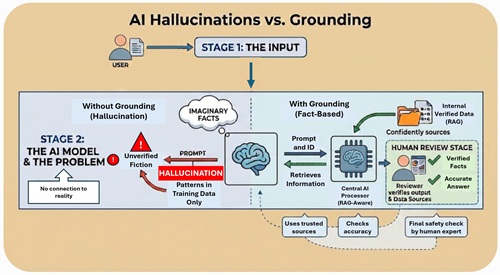 [Click on image for larger view.] Figure 1: AI Hallucinations.
Beyond RAG, strict system instructions and guardrails play a vital role in preventing made-up information. Engineers can explicitly program models to respond with "I don't know" whenever a query falls outside the provided context. Lowering the model's "creativity" setting (often called temperature) also forces the system to choose more predictable, factual word choices.
4. Our AI Expert Sees Business Opportunities
The Pure AI
editors asked our AI expert, Dr. James McCaffrey, to comment. McCaffrey was a founding member of the Deep Learning Group at Microsoft Research.
McCaffrey observed, "AI hallucinations are usually seen as a technical flaw. But they have sparked a thriving ecosystem of new business opportunities."
"AI companies that build reliable guardrails, produce hallucination-detection software and provide automated fact-checking platforms are finding a massive market. These tools are especially needed by risk-averse industries such as finance, law and healthcare. Solving the trust problem in AI has become a multibillion-dollar market opportunity in its own right."
McCaffrey added, "At the client companies I work with, an interesting side effect of AI hallucinations is that it's accelerating the corporate push toward clean, organized enterprise data. Companies are increasing their auditing efforts and structuring their internal knowledge bases. This digital spring cleaning appears to be unlocking significant efficiencies beyond the AI projects themselves."